[MUSIC PLAYING IN THE BACKGROUND THROUGHOUT THE VIDEO]
[Anne Dixon speaking on screen]
ANNE DIXON: How do you take a burden off of the shoulders of a clinician and make it easier to do their job?
[Anne Dixon in the clinic walking past the front desk, transitioning to clinic signage on the wall]
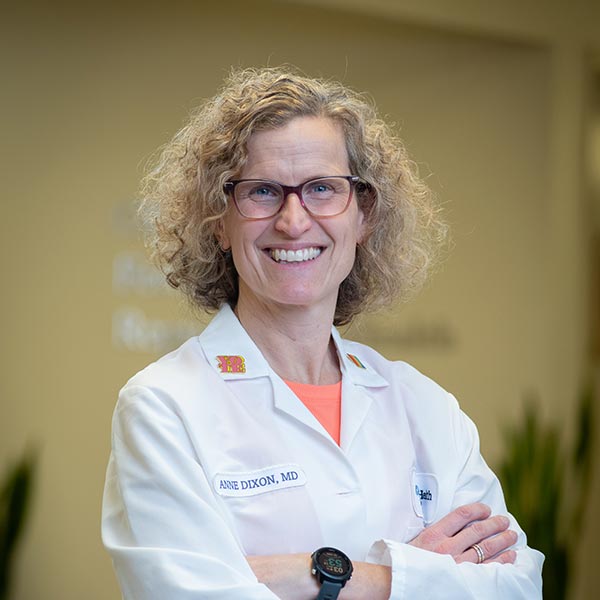
I'm Anne. I'm an OB/GYN physician, and I'm also a leader at Optum,
[On-screen text: Dr. Anne Dixon, Optum Physician Leader]
working to make the experience for our clinicians better.
[Split screen, women playing hockey, a photograph of Anne Dixon in a hockey uniform]
It's been over 40 years that I've been playing hockey.
[Split screen, Anne Dixon talking, a photograph of Anne Dixon in a hockey uniform]
One of my favorite things is to make a hockey analogy out of pretty much any work-related challenge.
[A whiteboard with notes on it]
The whole concept behind value-based care is that we work together as a team to take care of our patients.
[Anne Dixon talking with a colleague in her office, and talking with other colleagues in the clinic]
And the team is everyone, so everyone in the patient care journey, the receptionist when you walk in or the medical assistants. And the clinicians are like our goalies. If our clinicians are struggling, we cannot win in value-based care. We can only be successful if our clinicians are thriving.
[Anne Dixon in an exam room, putting on a blood pressure cuff on a patient]
Is there the support that you need?
[Anne Dixon working in her office, at the computer]
How many hours does a physician spend documenting in the electronic medical record versus actual face-to-face care with a patient? There's actually a term for it called pajama time, because it's literally the time people spend at night finishing their notes, putting in orders, answering portal messages. And so one of the ways that Optum has made a dent in this space is through using ambient documentation solutions.
[A smartphone on a desk, transitioning to a clinician talking with a patient in the clinic, at a computer]
It's literally a phone that we bring into the room. It has an app on it that's connected to our electronic medical record.
[Anne Dixon in an exam room talking with a patient]
So the phone is listening to what we're saying and it's turning it into a written document.
[Clinician holding a smartphone that displays a recording]
It's our note taker.
[Anne Dixon in an exam room talking with a patient]
What it has done is it allowed me to have eye contact with my patient. My work at Optum matters because we're all patients at the end of the day.
[Split screens, Anne Dixon working in her office, in an exam room talking with a patient, a hockey player taking a shot at the goal]
I want to know that I am getting the best care that I should be getting, because the person who's seeing me is at the top of their game, and that can only happen if they themselves are well cared for.
[Anne Dixon walking down the clinic hallway with a patient]
I am working to make the experience for our clinicians better. That's healthy Optumism.
[On-screen text: That’s Healthy Optumism. Patient Care, Pharmacy Services, Health Intelligence & AI]