Health care

We provide affordable and personalized care

How can we help?

Helpful links

Financial

Accounts to help you save and pay for health care expenses

How can we help?

Helpful links

  • Resources

    Find contribution limits, savings tools, calculators and eligible expenses

  • Account support

    Find contact information and frequently asked questions

Tax season resources

Get ready for HSA tax season

If you used an HSA this year, the HSA Tax Center offers general information about contributions, eligible expenses and commonly used tax forms — all in one place.

Pharmacy

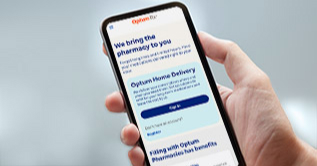
We make it easy to get medications you need, when and where you need them

How can we help?

Helpful links

  • Optum Rx

    For people with pharmacy insurance benefits through Optum Rx

  • Track orders

    Track your home delivery and specialty order

  • Pharmacy support

    Find contact information and answers to frequently asked questions

Mobile app

Optum Rx on the go

Request refills, track order status, manage billing information and much more.

Download on the App StoreGet it on Google Play

In this article

Turning data into better healthcare with AI 

July 13, 2026 | 5-minute read

Using AI to improve healthcare data clarity

Like a long rally in a game of ping pong, healthcare can sometimes feel like a constant back-and-forth: patients moving between doctors, answering the same questions and not always having a clear sense of what comes next.

Healthcare data plays a big role in that experience. While some information is structured — like diagnoses and medications — and fits neatly into databases, about 80% of medical data is unstructured, often existing in free-form documents like physician notes, referral letters and discharge summaries. 

“Take for example a handwritten physician note,” says Arati, who leads point-of-care solutions using AI at Optum Insight. “Not many organizations are able to truly home in on that unstructured data, and that’s why they partner with Optum.”

Combine that unstructured data with siloed provider and health plan systems, and it’s easy to see why providers don’t always have a complete patient picture needed to deliver the best care possible.  

“There’s one goal: Make sure that when a patient is in front of a provider, it’s a meaningful visit, and it starts with better data," says Arati.  

How AI connects healthcare data to patient care

AI helps recognize healthcare data patterns and surface insights that help providers guide the next steps in care.

Health plans often have the most comprehensive data, with access to claims — a record of visits, diagnoses and treatments across different doctors and settings. But they don’t always have the full clinical context, while providers do. They rely on their electronic medical record (EMR) and what a patient shares during a visit. But that view is often limited to what happens within their own health system, rather than across a patient’s full care journey.

Arati's team helps connect those pieces — bringing together health plan data and applying analytics to surface insights directly within the provider workflow — mining data from more than 40 health plans, 29,000 provider groups and 1,300 EMR systems. At this scale, connecting data helps support faster, more informed decision-making across millions of patient interactions each year.    

“What Optum does best is turn complex health care data into timely, actionable guidance delivered directly within the clinicians’ existing workflows, like the EMR,” Arati says. “Providers don't have to search through their notes, it’s right in front of them.”  

This translates into meaningful time savings for providers. Industry studies show physicians spend an average of 16 minutes per patient navigating electronic records in their clinical workflow. For many, that adds up to 3 to 5 hours each day, with about one-third of that time spent searching patient  information.

“Everyone deserves to have a visit where the provider knows their history, understands their current condition, and can provide the best care and next best action,” states Arati. 

The value extends beyond the point of care. For health plans, pulling forward the most relevant information enables earlier care intervention and a better ability to address gaps during the visit — which can help avoid complications and unnecessary costs over time. 

As AI enables more of these insights to be identified and acted on, Arati is clear that humans are always involved.

“While AI can help us understand data patterns and surface trends, human judgment will always be critical,” says Arati. “For example, AI might identify that a patient should be referred to a specialist, and our clinical teams review that insight before it’s put in front of a provider, adding a critical layer of clinical validation.” 


Where passion meets purpose

As a former competitive ping pong player, Arati is focused on driving better outcomes, whether at the table or in healthcare.

“I get very restless if rallies go on and there’s no outcome,” she says. “I like to hit the shot and get to the point.”

In her work, that means getting actionable data to both providers and health plans — leading to more informed decisions and better health outcomes for patients.

“What gives me optimism is that I can change healthcare in a positive direction by innovating every day.”

Related news

Laurie's Story: Carrying a Legacy in Home Delivery Pharmacy

News story

Laurie’s story: Carrying a legacy forward in Optum Home Delivery Pharmacy

Learn why Optum pharmacist Laurie has a passion for designing programs that make it easier for patients to get and stay on their medications.

June 18, 2026

How Home & Community Supports Patients and Their Pets

News story

Compassion in action: How Home & Community supports patients and their pets

Read about the shared mission between Alabama Hospice Care of East Alabama and Optum Home & Community to deliver whole-person care.

October 22, 2025